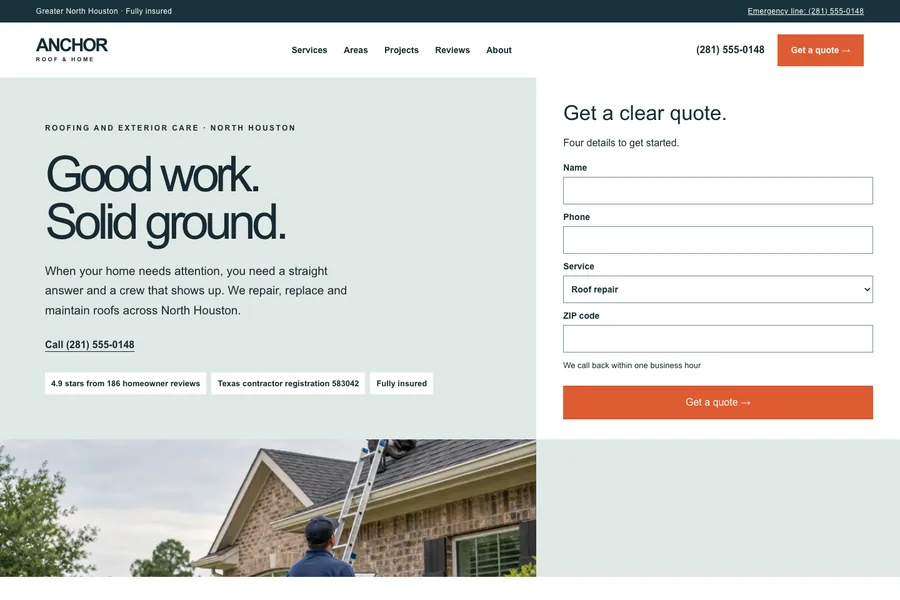
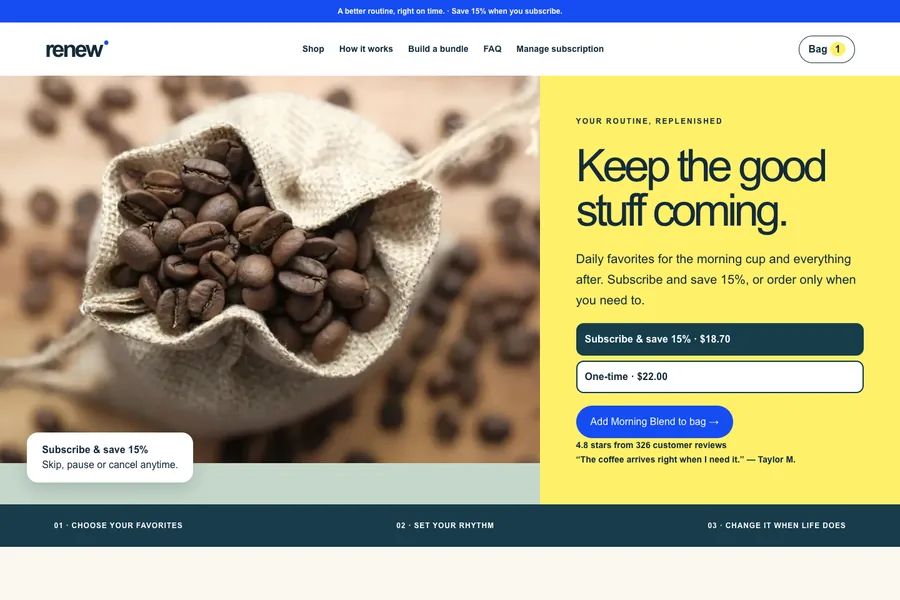
You own the code
A real Git repository, in your name, from the first build.

Websites, apps and automations, built from a sentence.
A few cents to build, from $10 a month billed annually to keep online.
A beautiful place to begin
6 considered designs for business websites and online stores.
Real pages to explore, useful sample journeys to try, and code you can make your own. See what building with Amelia costs
What you get
What the money is for — and what happens to everything you built if you ever stop paying it.
A real Git repository, in your name, from the first build.
Zip it, clone it, or push it to your own GitHub. Any time, plan or no plan.
Your sites online on your own domain, included with every plan that builds. How many depends on the plan — the count is on Pricing.
Your project runs on a machine in the cloud, not on your laptop. Nothing to install, and it works from a phone.
There are dozens of AIs and the priciest costs 80x the cheapest. We send each job to the one that does it well for the least. You just build.
The rate is under the composer before you send, and what it cost is printed on the answer. No credits, no packs.
Your code stays yours. Hosting stops a week later, and one click brings it back.
It tries your live site like a stranger would — leaks, broken links, slow pages.
Included usage resets each month, and credit you buy never expires. A site published on the free trial is a seven‑day preview on our subdomain; on a plan it stays up as long as the plan does. What each plan costs · everything it does, room by room.
Studio
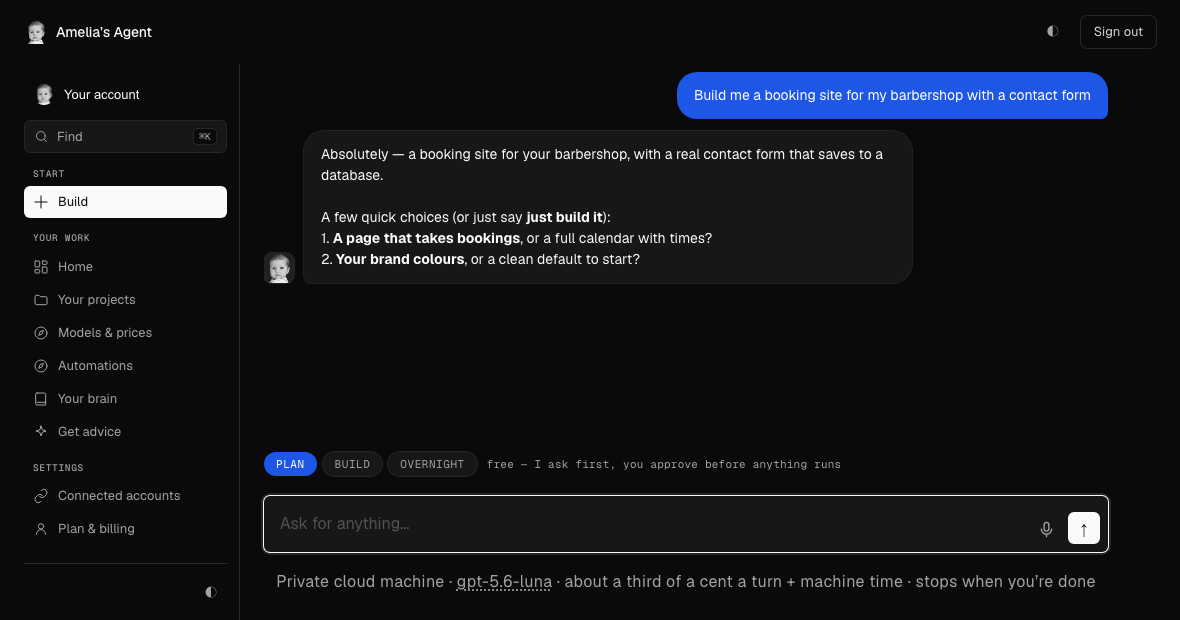
She asks the questions, writes the plan and prices the work before anything runs. The planning turns are priced like every other turn — what the model cost us plus your plan’s markup, about $0.0012 on the model we recommend, printed on the answer. Approve the plan and the build starts on a private machine — every file it writes and every command it runs on screen as it goes, with the cost of the turn on the answer when it lands.
Library
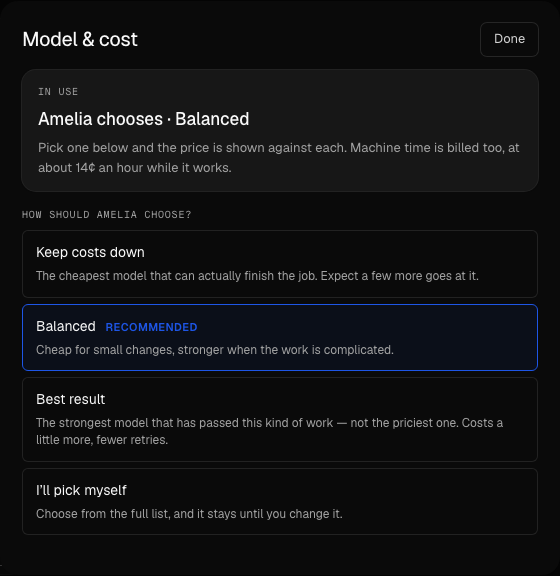
Balanced, best result, keeps cost down — or your own computer, or pick from the full list yourself. The price is shown against every one before you spend anything, which is the thing no other builder on this market will print.
Account
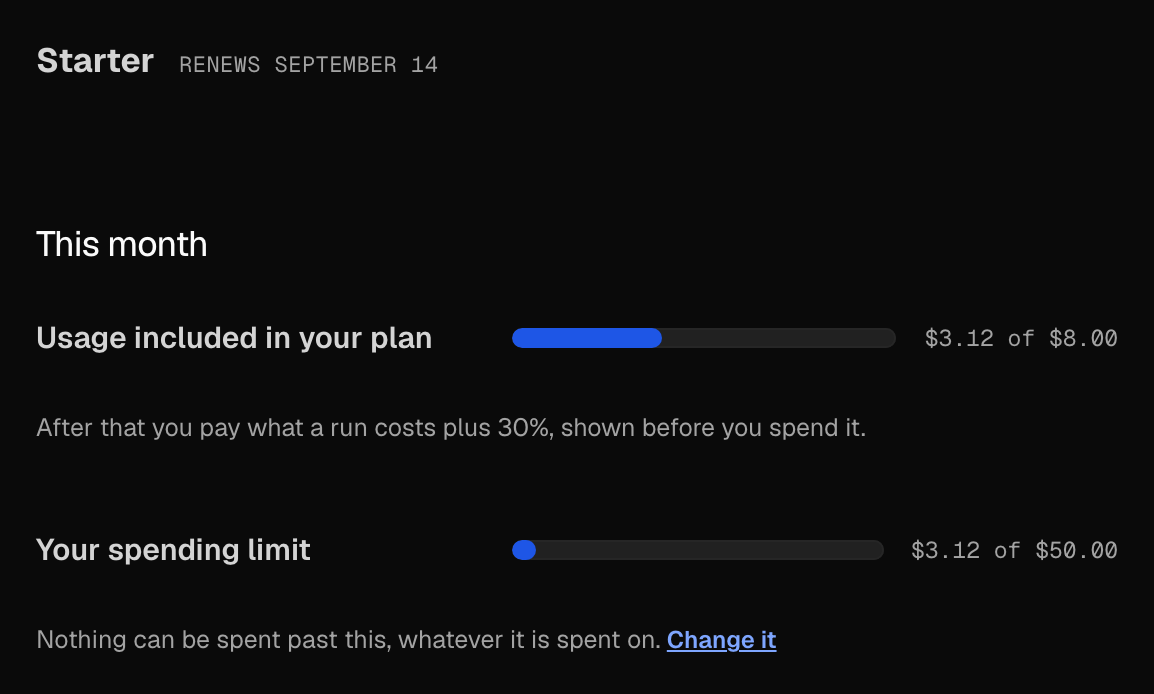
The fair objection to paying for what you use is that a mistake could cost a fortune. So the ceiling is on before you have spent anything, it is yours to set, and reaching it stops the next turn rather than sending you an invoice.
Not just websites
Real builds, running right now — tap one and it opens in a new tab to play. Every one was described in a sentence and built by Amelia, and every score is saved to a database we host, shared across everybody rather than just this browser.
Against the alternatives
Credits are a currency with no published exchange rate. Seats are a bill that arrives whether anyone built anything or not. Here the unit is a dollar — so set the usage yourself and read the answer off the chart, rather than taking ours at the one level we would have picked. Ours is the only line on any of the three charts that moves, because everybody else sells a flat subscription — and a flat bar is not “cheaper”, it is the price of a box whose contents they do not publish.
If every single answer used a frontier model at $0.05 instead, the same plan would be $33.49 — the worst case, not the normal one.
| What you get | Amelia’s Chat AI | ChatGPT Plus | Claude Pro | Perplexity Pro |
|---|---|---|---|---|
| The price of the answer, printed on the answer | yes | no | no | not published |
| You pay for what you actually asked | yes | no | no | not published |
| No five-hour usage window | yes | no | no | not published |
| Files, photos and videos in the chat | yes | yes | yes | not published |
| Memory that carries between chats | yes | yes | yes | not published |
| Upgrade to a plan that builds and publishes | yes | no | no | no |
| What you get | Ours | Lovable | Replit | Bolt | Base44 | Retool |
|---|---|---|---|---|---|---|
| The price of the build, before and after | yes | no | no | no | no | no |
| Choose the model | yes | no | not published | not published | yes | no |
| Your code as a git repo from the first turn | yes | no | no | no | no | no |
| You pay for what ran, not for credits that expired | yes | no | not published | no | not published | no |
| Run it yourself for $0 | yes | no | no | yes | not published | no |
| What you get | Enterprise | ChatGPT | Claude | Retool | Lovable |
|---|---|---|---|---|---|
| Everybody at the company included, no seat fee | yes | no | no | no | not published |
| Adding somebody costs nothing | yes | no | no | no | not published |
| The price of every turn, printed on the turn | yes | no | no | no | not published |
| A budget per person, and a request when they hit it | yes | not published | not published | not published | not published |
| A price published at all, at this size | yes | yes | yes | yes | no |
The same six questions, asked of Lovable, Replit, Bolt, Base44 and Retool too — the full comparison. The expensive model is a choice here, not a default: the app suggests the cheapest one that does your job well, and the savings are yours.
Amelia’s Chat AI, $5.99 a month — $4.99 billed yearly — with $2.50 of usage included and every answer priced on the answer. Files, photos and videos, memory that carries between chats, and a link to share any of them. No builds and no machine; move up to Pro when you want something put online.
Chat is charged, like everything else here · every answer shows its price
What happens
The same five whether you have written code before or not. Nothing to install, nothing to configure, no build settings to learn — everything between the sentence and the live URL is done for you.
You type what you want
Plain English. One sentence is enough to start
It asks what it needs to know
Your name, your hours, what you actually sell — each answer shows its price, and no build machine is running yet
It builds it
A private machine starts in about ten seconds. Every file, the clock and the running cost, in front of you
You look at it
It renders in the answer. Full screen at phone, tablet or desktop width
You put it online
One click, a real URL, a real certificate
What this actually is
There is no such thing as one AI. There are hundreds, they are good at different things, and they cost wildly different amounts — so most tools pick one for you, never say which, and bill you in credits so you cannot tell what anything cost. Amelia picks the one that does your job well for the least, shows you the price before you spend it, and lets you overrule her. You do not have to know any of their names.
The detail, for anyone who wants it: over 300 models — American, Chinese and European, frontier and budget, each with its published price on screen before you spend anything. Seven of them we have measured ourselves and the app suggests one per job. The cheap end is not a consolation prize: on four of the five job types we measured it finished first time, and a model eighty times the price was barely better.
Run the whole agent on your own hardware, with your own model keys, and we charge nothing at all. Own hardware makes the machine free; own keys make the turns free.
Your account, your rate, your limits.
Ollama or LM Studio — $0 per token, forever.
Even while you drive it from the app. The desktop app does it in one click.
Point it at what you have — it reports what to cut.
Same agent, same interface, three commands to install. The hosted machines are a convenience, not a lock — run it yourself and we operate nothing that can read your code, your keys or your history. Your prompts still go to whichever model you choose, unless that model is running on your machine too — in which case nothing leaves it at all.
Six of the ten we measured, one average turn each, with our markup already in the number. Bars are linear, so the cheap end really is that small.
Where people start
Each of these is a real page rather than an anchor, and each one carries a measured figure — recognising yourself in a number is a faster decision than recognising yourself in a description.
And you were about to pay a builder every month, a designer once and a developer again after that. Describe it instead, and own what comes out.
One measured build: 12 turns, $0.03 of tokens
A booking form, a customer portal, something to replace the spreadsheet three people are fighting over. Usually not hard. Usually expensive.
53 real builds in the showcase, every price shown
Point it at software you already run. It reads the stack, names what you could own instead, says what is genuinely worth keeping, and builds the difference.
It reports before it rewrites
This is not only for starting over. Point her at what you already run — a live site, a repo, a half‑finished project — and every change after that is a sentence.
She reads it first and reports — what is slow, what breaks on phones, what you are overpaying for. Then she makes the changes you approve, and only those.
Connect GitHub and import the repository. It stays private by default and she works in it commit by commit — yours before, during and after.
Paste a repo or a markdown address — an AGENTS.md, a CLAUDE.md, a project note — and its facts join her memory of your project before the first turn runs.
Writing code for a living? The same thing, with the repo, the shell and the model choice you would expect — for developers.
Where it lives
A repo is a folder with a memory — every version of your project, every change, with a note saying what changed and when. We make one for you on the first turn, host it, and never charge for it. It is private unless you say otherwise, and you can take a full copy of it whenever you want. Nobody has to ask you to remember to export anything.
Stopping is not deleting, either: your projects and everything Amelia learned about them are still here when you come back, so starting again is not starting over. And every project has a memory of its own — your colours, your business, the decision you made three weeks ago.
You stop paying for it the moment it stops. Nothing you care about lives here.
On our git host, free, private by default — and mirrorable to your own GitHub if you would rather it sat there too.
Committed after every turn, with a message you can read. Plain git — clone it, fork it, push it anywhere. Never a separate bill: hosting your code is not a product here.
Not a developer and none of that means anything to you? It still matters, and somebody you hire later will know exactly what to do with it. See your code.
The sandbox is ours and the git repository is on our server in Germany. It is private to your account, and you can clone it and delete it whenever you like. We are not going to pretend otherwise.
Run the agent yourself and the code, the keys and the history stay on your computer. We operate nothing that could read any of it. Your prompts still reach whichever model provider you pick — point it at a local model and even that stops.
Going live
Publishing a site is free on every plan — a real address with HTTPS, hosted on our own hardware, and you can take it offline any time. On the free trial it is a seven‑day preview; a plan keeps it online and puts it on a domain you own.
No build configuration, no dashboard, no deploy pipeline to learn. Prefer your own Vercel, Netlify or Cloudflare? It is a git repo — point them at it.
It exists in your repo. Nobody but you can see it.
One click. What goes out is what was committed, not whatever was on the machine.
A real address with a real certificate, in seconds. Send it to a client today.
Keep the free address you are given — it is a real web address you can hand out. Point a domain you already own at it when you are ready, or buy one anywhere that sells them and we will show you what to change.
Shared, not sold
The bill here is turns, not tokens — so the cheapest build is the one that does not start from an empty directory. Anyone can publish what worked for them, and anyone can install it into their own project before their first turn.
Browse the marketplace · start from working code · what it already knows about each job
Published by people using it, installed in one click, free
What it costs
Free to try, with no card — enough to build something real and put it online, and what you make is yours whether you carry on or not. After that it is $10 a month for a site or two, or $29 for most people, with usage included. The rate is under the composer before you send; the cost is printed on the answer.
On your own computer it is free outright — every feature, your own keys, or a local model that costs nothing per token. No machine time either; it is your machine.
The rest of the rate card, for anyone comparing: past your plan’s included usage a turn costs what the provider charged us plus a margin that falls as your plan goes up — 30% on the trial, Amelia’s Chat AI and Pro, 28% on Pro Plus, 22% on Pro Max, 20% on Enterprise. Every row, in a table.
Or see what it costs first
Cheapest model to best one — a 129× spread, and the app suggests which to use for your job. Machine time is from about $0.22 an hour on top. Quoted at the trial rate, the highest we charge. On your own machine: free.

Free to start, no card · no seat fee · no credits · a spending limit on from day one · when we cannot price something honestly, we say so. The whole price list.
Billed by the minute you actually held it, and it stops itself when you are done. You do not need a computer of your own, and you are not paying for one while you sleep.
Free to begin, no card. Whatever you make is in a repo you can clone, whether you carry on or not.
Every answer shows its price · a spending limit is on from day one · the code is yours from the first turn
iPhone · TestFlight
The same account and the same projects, in a real iPhone app. Free while it is in TestFlight.